
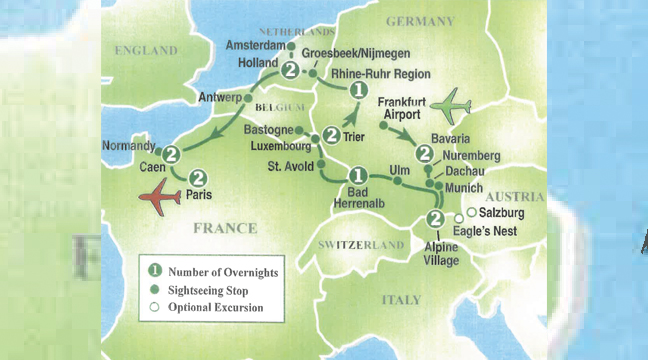
(EDITOR’S NOTE: Former Citizen Publisher Gary W. Meyer spent Oct. 1-15 visiting 15 World War II sites. The following is the second of a three-part series on those travels.)
Normandy is not a welcoming place. It’s known for something else – the loss of life in one of the largest and most grueling land invasions in the recent history of our planet. Eighty-one years, that is.
June 6-9,1944, our country, in legion with Allies England, Australia and Canada, threw our mighty fighting weight against hated Germany, which had been for five years terrorizing its neighbors.
The wind blew hard off the English Channel, to some effect the strength of the storms that blew our heroes to the beach 80 years prior. The lands inside the attack beaches were sand, with wisps of beach grass.
We visited first the bunkers of the Germans manned to mow down our troops as they climbed the cliffs of Pointe Du Hoc and Utah Beach, commanded by Gen. Omar Bradley. Pointe Du Hoc was a killing zone for the Americans. Seventy-five percent of our forces suffered either fatalities or war wounds. Their main fighting tool besides their carbine was a grappling hook attached to 100 feet of rope. It got them nose to nose with the Germans.
To the north, Americans ground up the beach at Omaha. Omaha posed its own life-threatening issues for the Americans. Omaha Beach was a near-thousand foot open yard at which the Germans, from higher stations, could bore their machine guns down on the attacking Americans. The German 7th Infantry Division was the defender.
The British and Canadians attacked the beaches to the north, landing zones Gold, Juno and Sword. The German 15th Infantry Division defended against them.
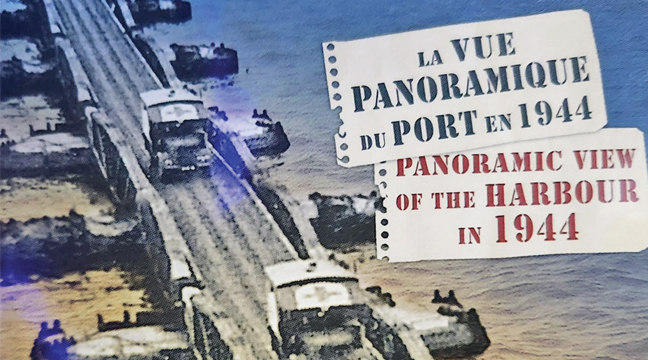
The invasion would not have been possible had it not been for the design and implantation of the mullberries bridges built in the weeks before in Britain. Locked together, the 280-foot x 50-foot wide x 65 foot deep metal segments formed bridges that went far into the water and then to shore to transport nearly 100 percent of landing craft, troops and materials up the beach. It is reported 3.1 million tons of supplies reached shore due to their efforts. When fighters and materials and vehicles were connected, the charge was on for the Allies.
Nearly 196,000 naval forces were involved. Warships counted 6,800. Aircraft totalled 11,990, of which 3,500 were gliders. Land forces counted 157,205. Over 438,000 vehicles came ashore.
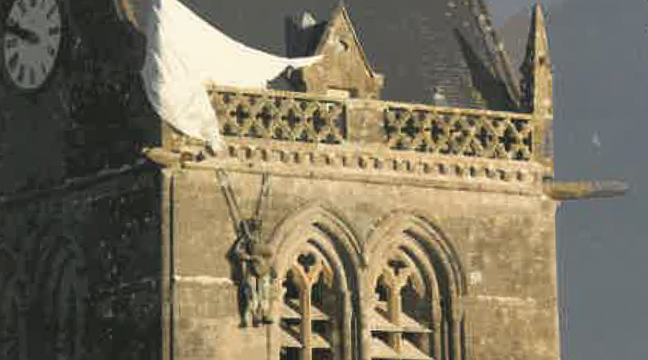
Two stories of note. While Allies were barnstorming the beaches, the American 82nd AB Division was paratrooping at night into St. Mere Eglise, just miles to the southwest. One of the troopers became famous for his unfortunate landing, snagging his parachute rigging onto the steeple of the church, 90 feet above the parish yard. The Germans below spotted him but couldn’t hit him – and he lived to fight another day. He did have hearing loss due to the church bells ringing close by that night. The scene was played by American Actor Red Buttons in the 1960’s picture, The Longest Day. Another scene from the movie featured a British paratrooper division capturing the Pegassus Bridge, 20 miles inland, just 11 minutes after the start of the invasion.
Just a few miles inland is located the American Cemetery at Normandy, where 9,387 of our troops are laid to rest. Most of those interned lost their lives the first four days of the invasion.
A second most-noted cemetery is the American Cemetery in Luxembourg, where the famous Gen. George Patton is interred. He asked to be buried with his soldiers if he died in Europe. When he was killed in a traffic accident over there, his wishes were granted.
The Allies made good progress in the months since Normandy, liberating Paris (a great coming-out) in July and Caen in early August. From there, efforts were directed further to the east, north and south.
The Battle of Bastogne
There was no period of the Americans’ involvement in the European Theatre that was more dramatic than their time in Bastogne, Belgium during the last months of 1944. Our troops had gotten themselves into a strategic tangle with the Nazis and were surrounded in what became the Battle of the Bulge.
The Germans, aware of their advantage, approached Gen. Dick McAuliffe for a surrender. Just out of bed at 10 a.m. after a night of fighting, Gen.McAuliffe responded to reading the German message, exclaiming, “Nuts’”.
The Germans, not knowing what “nuts” meant, dawdled for hours while the Americans got their act together and went out and claimed superiority on the field in January, 1945. Gen. Patton’s forces were on the scene along with the Brits and helped save the battle.
American soldiers paid a heavy price in Bastogne. Members of the 101st AB Division, pinned down by German artillery fire, attempted to dig fox holes in frozen ground in a pine plantation to save their lives. They barely dug a foot into the ground before they ran into pine tree roots. We saw the fox holes in the forest that October day. And we celebrate our heroes who persevered.
We need to talk about the local residents who resisted in the face of demonic Nazis who took over their lives - and killed them, if the mood was right.
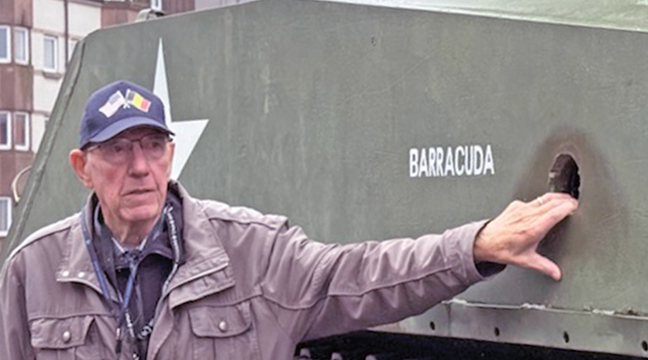
Near 90, Henri, our Belgian tour leader, led a wonderful visit in Bastogne. He introduced us to the “nuts” general’s statute and led our tour of the states museum, in appreciation for our wartime efforts. He led us to the forest where the Rangers dug their foxholes.
And he told the story of his father, confronting an SS officer while in their home in the early stages of the war. The SS officer demanded to know where his (Nazi) men were (in the house they commandeered away from Henri’s family).
Henri’s father repeated his message – that he knew nothing about additional Nazi soldiers, whereupon the SS officer pulled out his service pistol and fired two bullets into the father’s chest. Henri’s family escaped to a relatives’ home and lived out the war.
Henri joined the Belgian army after the war and has spent much of his adulthood talking about the war. There is a resolve in his demeanor and a love for comrades who saved his country. God bless him and the millions of other Europeans forced into defending their homes from the tyrants with the swastikas.
(Next, a final story, featuring the First World Court, facing the Nazi elite at Nuremburg.)