
(EDITOR’S NOTE: Former Citizen Publisher Gary W. Meyer visited 15 World War II sites in European early October, 2025. The following is the last of three installments in coverage of his visit).
It was September, 1944 and the war was going well for the Allies. Their new focus became the Nazi occupation of Holland on the far north end of affected nations. The British and American assault groups were quickly at work, planning their air and ground attacks at Arnhem. Success in their offensives meant they would enter northern Germany and subdue its Ruhr industrial region.
But, not so fast. The Germans proved strong resistance, with their Panzer armor divisions and ready combat troops. The Allies also got their paratrooper landing zones mixed up and the result was a colossal defeat. Germans either killed or incapacitated 8,000 British soldiers and the Americans suffered nearly as badly. Their military cemetery in Holland contains the remains of their losses in-country, about 5,500 and most of them were boys shot out of the sky before their boots got on the ground. One error for the American paratroopers was being landed 12 miles from their target.
So, the Allies essentially had to gather up and withdraw from the fight Sept. 22, and move on to their next big battle, which was in Bastogne, Belgium two months later. And our friends in Holland had to wait out another year of German occupation before their war would end. (A movie depicts the mission in Holland and it is well worth seeing. It’s entitled, A Bridge Too Far.)
Tour director at the Nemjemen, Holland war museum, Renee Schoenmaker, told the story of each country’s losses in the war. The numbers are staggering. Russia lost 22.1 million residents and military, Poland lost six million. Italy, 472,000; Netherlands, 210,000; England, 451,000; Belgium, 85,000; United States, 451,000; Germany, 7.1 million.
“The war cost 80 million lives worldwide,” he said. “If I had an opportunity to talk to Hitler after all this, I would ask him.’’ ‘Is it worth it’?”
So, the Allies left Holland to fend for themselves and headed south to Bastogne, where they would soon engage the Nazis in the bloodiest battle of the entire war. With grit, they turned the tide against Germany and by mid-January, 1945, began making their way eastward into Germany. Approaching Berlin, the Allied commanders agreed; Britain would enter from the west, the Americans from the south and the Russians from the east. The battles were over in mid-spring and on May 8, 1945, the Allies celebrated Victory in Europe (VE) Day.
Nuremburg Trials
As the region began to regain some of its sanity that summer, Allied leaders proposed there should be a court to try the Nazis for their atrocities. But no court existed. Allied Commander Ike Eisenhower suggested, “Take them out and shoot them.”
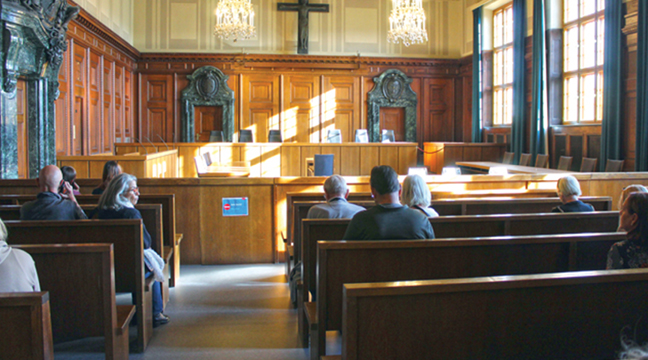
Russian Commander Stalin wanted a little more blood, saying the top 50,000 Nazis should catch a bullet. That wasn’t too practical. The Allies agreed, Germany would need some of its wartime leaders to (with psychological reconditioning) become peacetime leaders. So, that became the plan. With France, Britain, Russia and the United States sharing equally, the court was established. Each country was to contribute two prosecutors for the trial. American prosecutor Robert Jackson was to be lead prosecutor, and he formulated the plan for the court.
Nuremburg was selected by the Allies to be the site for the trial because it held memories of near-sacred past activities for Hitler as he forged his party beginning in 1933. The parade grounds in Nuremburg, twice visited by me, were an eerie place. I sat on their concrete benches just a few feet from where the Fuhrer stood in his time, watching his “war-fury” people celebrate his idea of German superiority.
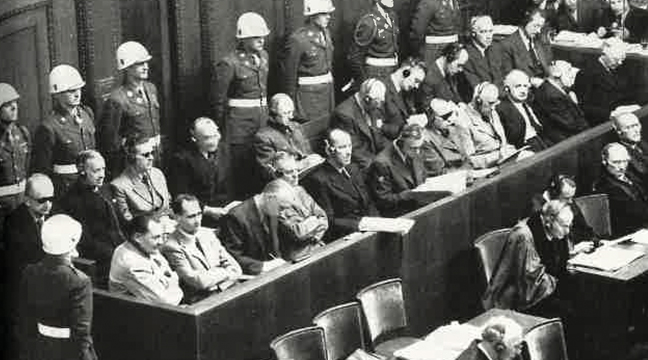
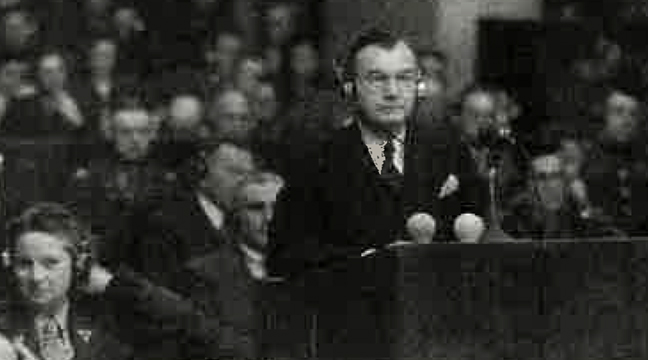
The design of the court case was to try 24 Nazi leaders, though the actual docket was trimmed to 21 for the trial. Not all the defendants were known as political heavyweights.
Hitler, his right hand man Joseph Goebbels and Heimrich Himmler, minister of propaganda, were already dead by suicide.
So, who was left? Hans Frietschke, radio journalist; Hjalmer Schacht, Riechbank president; Hans Frank, Nazi party lawyer; Albert Speer, armaments minister; Fritz Sauckel, forced labor deportation; Arthur sef-Inquart, deportation of Jews; Balder van Schuirach, Hitler Youth program; Konstantan van Neurath, foreign minister; Alfred Rosenberg, established Eastern Jewish ghettos.
Four military officials were in the docket. They included William Keitel and Alfred Jodl, Army; and Erik Raeder and Karl Donitz, Navy, Other defendants included Ernst Kalentenbrunner, SS office Berlin; Walter Furik, economics professor; and Julius Streicher, Nazi newspaper editor.
Four very prominent Nazis sat in the front pew of the defendants docket. They included Rudolph Hess, who tried to escape flying to Britain in 1941, only to be captured and returned after the war. William Frick, interior minister; Joachim von Ribbentrop, foreign minister; and their ultimate leader, Hermann Goring, supreme commander and person in waiting to lead the country in Hitler’s demise. He took it upon himself to intervene on behalf of fellow defendants during proceedings.
The trial for these defendants took almost a year. Majority were found guilty and a few released after prison terms. Some later committed suicide. Most notably, Goring wouldn’t “go alive.” Despite strict rules to keep contraband from the prisoners, Goring secured a tablet of cyanide and placed it inside his rectum in the privacy of his bathroom. He died on his own time, causing lots of stress for the Allies.
Our tour group witnessed a photo taken of the defendants after their deaths, stretched out on gurneys, for the world to see in their local papers. It was a retched scene. But the world had to know.
Our guide, Bieke, in answer to my question, noted the dead were burned up, as they had done so to many millions. Their ashes were taken to a river in nearby Munich and unceremoniously deposited there.
So, there is no trace.
Following World War II, it was determined an international court should be established in The Hague, Netherlands. It has since hosted trials for Serbs accused of atrocities in the Bosnia War of 1991-94.