
I think a lot of people believe that nature can be predictable, on a regular schedule or completely understandable. An experience that I had yesterday shows that nature can never be predictable, or understandable.
I am writing to you from cold and snowy Yellowstone, where I am in the middle of leading two groups of photographers on a winter wildlife photography adventure. Yesterday while in a very remote part of the park, accessible only by large snow coaches, think monster truck, that it is very comfortable for traveling long distances in snowy conditions. We spotted a Red Fox (Vulpes vulpes) on a distant snowy ridge. It was clearly hunting because it stopped often to cock his head from side to side while listening to small mammals under the snow.
This looked like it might turn out to be a good photographic opportunity, so we climbed out of the snow coach and started to set up our tripods and cameras in anticipation of capturing some hunting action. One of the major goals of these photo adventures is to capture images showing the winter environment and how the animals interact and survive in harsh weather conditions.
The fox clearly saw my small group and paused to look at us before it went to a wind-blown snowy ridge and sat down and curled up to rest. Of course, we were all disappointed, but I figured it was worth waiting around to see what transpired. After 45 minutes the fox got up and stretched. The fox started moving towards us and I thought we might get lucky, but instead it turned and disappeared behind a short snowy ridge.
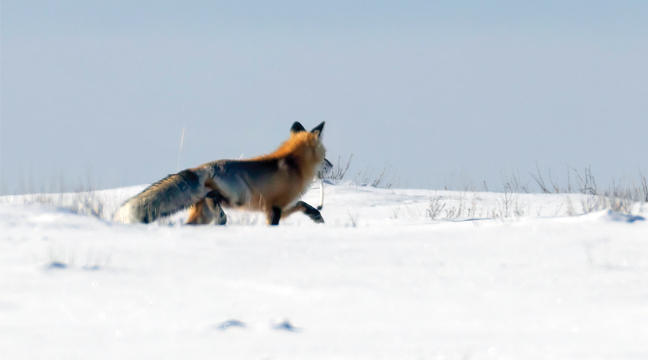
After a few minutes we could see the fox pouncing on the snow surface, like a Polar Bear does when trying to break through sea ice to catch marine Seals. What happened next was the hard to understand and totally unpredictable part. The fox crushed through the snows surface and came up with a Long-tailed Weasel (Neogale fermata) in its mouth. I was shocked. I have heard about this happening but never witnessed it myself.
The Long-tailed weasel is a slender, carnivorous predator that makes a living by eating small mammals such as mice and voles. They are a fierce predator that has brown fur in summer and changes to bright white in winter. They are super active hunters moving across the snowy surface then burrowing into the snow to find their prey. They hunt both day and night to find their prey in burrows underground or in trees.
Long-tailed Weasels range from southern Canada down across most of the United States and into Mexico. They are one of the larger weasels and appear hyperactive when out actively hunting. The point is, the Long-tailed Weasel is a predator and an efficient killer. So, it’s difficult to understand a predator killing another predator, but yet right in front of us this happened.
I am continually amazed at the complexity of Mother Nature and how it finds ways to survive in the most surprising ways.
All of this took place over 300 yards away on a bright sunny winter day so unfortunately the images I was able to capture are not of very high quality. In fact, they are terrible images, but I did manage to process one to illustrate this story and show you what happened. You can see the long white tail with a black tip, clearly showing that it is a Long-tailed Weasel. It doesn’t happen often, but predators do kill other predators, and here is just one more example of how it goes in the wilds of Yellowstone. Until next time…
Stan Tekiela is an author / naturalist and wildlife photographer who travels the U.S. to study and capture images of wildlife. He can be followed on www.facebook.com and www.instagram.com. He can be contacted via his web page at www.naturesmart.com.