
Every year, within a two-week window around Christmas day, I participate in a long-time traditional bird count, called the Christmas Bird Count or (CBC). This is a world-wide effort by volunteers to take one day to go out and count all the birds they can find within a pre-defined area.
To understand this better, let’s look back in history. In the late 1800’s, it was Christmas holiday tradition to go out with your family or friends and participate in “Side Hunts”. This was a contest to see which group could shoot as many birds and small animals as possible including songbirds.
In the year 1900, an Ornithologist named Frank Chapman, an officer in the fledgling Audubon Society, which will later incorporate into the official Audubon organization in 1905. He suggested that instead of killing birds at Christmas, we should count or take a census of the birds. In the first year, 27 bird watchers went out and counted birds in 25 different locations in Toronto, Ontario, and Pacific Grove California. And with those humble beginnings, the Christmas Bird Count began.
Today nearly 100,000 volunteers participate in the CBC annually, making the CBC one of the world’s largest citizen science projects. It takes place mainly in the western hemisphere from Canada through the United States, down through central America and into the Caribbean. Europe has a similar, yet much smaller, CBC that is run by several different groups.
So, is the CBC important or is it just a reason for nerdy bird watchers to get together and see some birds? The data collected and compiled by Audubon Society provides solid evidence-based data that helps researchers, wildlife agencies and ornithologists that study birds and their long-term population trends, health, and declines, all across America. It’s key data when it comes to making decisions for protection of individual species, habitats, environmental issues and more.
The data found in the CBC has been used in many landmark environmental policies and laws. Now it is being used to help track the effects that climate change has on bird populations and so much more.
For my CBC, I am assigned a unique area that includes a large metropolitan airport and surrounding area. It was a very sunny but cold and windy day. The wind is never a friend when trying to see birds, especially when the temperatures are well below freezing. Over a 6.5-hour day (the days are short at this time of year), I saw hundreds of birds, most of which are common and widespread.
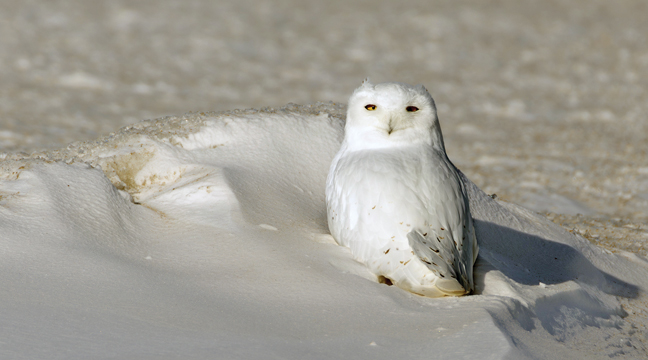
But every now and then you come across a species of bird that makes all the effort worth it. I was searching an open wind-swept area with my binoculars. Just before sunrise we received a light dusting of snow. Now with the clear skies and winds over 20 mph, it looked like we were having a mini ground blizzard. I searched and searched and eventually saw a shape standing out against the white snow. From a distance, I studied the shape, trying to make it into a Snowy Owl, but the longer I looked the more it appeared like a mound of snow. I moved a little closer and took another look. Then just as I was going to give up and move onto another area, I saw the pile of snow swivel its head and a pair of squinty yellow eyes appeared. It was indeed an adult male Snowy Owl trying to take shelter behind a large pile of snow.
I was able to grab a couple images without disturbing the owl or causing it to fly. It was another memorable CBC. To consider volunteering to be a CBC’er yourself, check your local bird clubs or Audubon Society. It will be well worth your time. Until next time…
Stan Tekiela is an author / naturalist and wildlife photographer who travels the world to capture images of wildlife. He can be followed at www.Instagram.com and www.Facebook.com. He can be contacted via his website at www.NatureSmart.com.