

At a workshop in May before the county board, Sherburne County Sheriff Joel Brott presented a plan to expand capacity at the jail for Immigration and Customs Enforcement (ICE) detainees.
The discussion focused on a request by ICE for proposals (RFPs) to provide 500 beds for detainees. Currently, Sherburne County has a five-year contract with ICE to provide 300 beds. That contract expires in 2022, at which time the contract would be renegotiated.
However, Brott told the commissioners ICE is looking to consolidate its prisoner population location. Freeborn, Nobles, Kandiyohi and Carver counties also have contracts for housing detainees.
Brott said because of ICE’s decision to consolidate, different law enforcement agencies have been invited to submit RFPs. He said if the county wanted to continue to have a contract with ICE, it would likely need to go through an expansion to the full 500 beds.
In May, Brott said an expansion to 500 ICE beds would also involve meeting new standards and an upgrade in infrastructure, which would mean increasing capacity in areas such as the kitchen, laundry, receiving and intake.
At the conclusion of the workshop, members of the board agreed if there was an expansion, it would make sense to do the most to be competitive.
“Go big or go home,” said Commissioner Tim Dolan at that time.
Sherburne County submitted its RFP in late May. This week, Brott said things have changed a bit since then. Now the county is not in the RFP process, but is in discussions with ICE about the current contract.
The possibility of expanding for ICE detainees has met with opposition from some groups within the county.
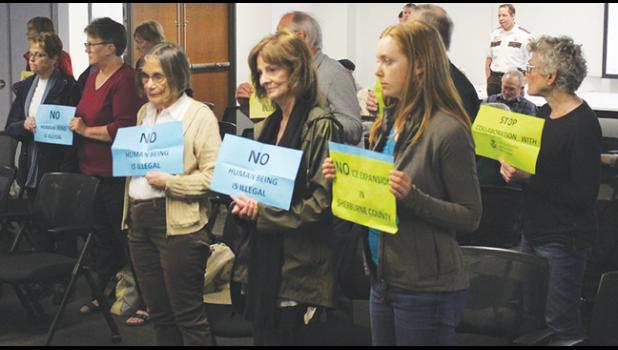
Pastor Robin Raudabaugh of Union Congregation Church in Elk River, was the spokesperson for about 15 members of SARI, (Sanctuary And Resistance to Injustice) during a county board meeting just after the county submitted its RFP. Members of the group stood while she spoke. Each carried signs of protest calling the contract with ICE, “blood money”.
“Residents of Sherburne County should be dismayed and appalled at the eagerness of county elected leaders to strengthen our relationship with a government agency that continues to separate families, takes children and violates court orders to reunite families,” she read.
The group and others have been protesting weekly outside the Government Center, hoping to raise awareness and make an impact on members of the county board, who will ultimately decide on any expansion project.
Commissioner Felix Schmiesing says although the county board didn’t vote at the end of the workshop, he felt no one was against the possibility of an expansion.
“We’re just reacting to what the courts decided - doing what is asked of us,” he said. “We don’t make those rules. We don’t sentence people. We don’t decide when they’re coming or when they’re going. We’re simply controlling a piece of the puzzle. We’re doing the best job we can for the people that are being detained.”
Commissioner Raeanne Danielowski says the board has an obligation to look at expansion and the contract the county has had for over two decades.
“I think as a board we decided it was our fiduciary duty to make sure we’re exploring every possibility for the county,” she said. “We need to do the right thing for the constituents. We’re still in that process.”
Schmiesing agrees.
“I think at this point if we didn’t explore this expansion and maintaining this contract, we would be not doing what’s expected of us. We have a significant investment, and it’s there because of our taxpayers’involvement,” he said.
Brott said although the contract is in place until 2022, the county will likely hear something from ICE long before that. Any expansion project will take months of planning and design, possibly close to a year in construction, and a significant monetary investment. The jail expansion in 2005 cost $16 million.
Schmiesing says it’s up to the board to decide whether an expansion and the Federal contract serves the interests of the county.
“My thought has always been that we need to make sure we’re covered - that the return, whatever we’re getting per diem, needs to be enough to cover the cost and needs to be ongoing,” he said. “We can’t put ourselves at risk for 20 years with a five-year contract.