
Plans to create a storm sewer improvement district along Co. Rd. 75 in Clearwater have been put on hold.
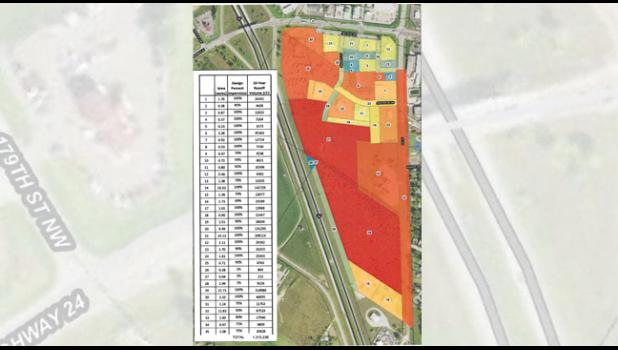
In November, the city held a public hearing to determine the scope of a stormwater taxing district that could help pay for a future trunk storm sewer project to serve about 35 parcels bordered by Hwy. 24, I-94 and Co. Rd 75.
The city’s engineer determined the storm sewer system is necessary because of potential groundwater contamination from surface runoff within the city’s Wellhead Protection Area. Under rules set by the MN Dept. of Health, any development of those parcels would require a stormwater plan to address that runoff.
Earlier this month at a workshop, Engineer Justin Kannas of Bolton & Menk said a stormwater improvement district might not be the best option for the city. Originally, city officials believed all the properties within an improvement district could be assessed according to the amount of runoff they produced, which seemed to be an equitable solution.
But at a follow-up workshop in early December, Kannas said there were issues with establishing a storm water district.
He said after speaking with the county, which would be administrating the district, he found out tax-exempt properties couldn’t be assessed. And one of the biggest parcels in the district would be owned by MnDOT and be tax-exempt.
Another issue: Under tax law, parcels within the district could only be assessed according to their fair market value, not by the amount of runoff they produced, which would not be an equitable way to pay for a project.
“So if you have a 20-acre parcel with a lot of impervious surface, it’s going to have a large runoff,” he said. “But a 20-acre parking lot will have low market value compared to other properties. It’s not the most fair way.”
He said a better, more equitable way would be to go through the 429 process similar to a street project. In that scenario, properties are assessed by road frontage and by volumes of water contributing to the drainage system.
Also, under the 429 process, tax-exempt properties can be assessed.
Kannas said there is a drawback to the process, though. Like a road project, residents would have the opportunity to challenge the estimated benefit to their properties.
But he said there would be a fair assessment based on the project cost and the contributing stormwater runoff.
Kannas said another thing the city could consider is signing developer agreements for any properties when they are developed. The agreement would individually assess the benefit.
He said a feasibility study would be the next step to determine options for the exact route of the pipe, the pond area and the cost.
“The critical timing perspective is getting the feasibility stage in place and getting a plan on how the city is going to move forward on this,” he said, “so that developers coming in know what the plan is.”
He said the study would cost between $15,000 and $20,000.
Later in the meeting, the council approved moving forward with a feasibility study.