
I’ve noticed an unusually large number of sandhill cranes flying over the farm so far this year.
I don’t always see them, but it’s easy to recognize their trumpeting call as they fly by.
It could be a few from a larger flock. Or maybe its just the same few going back and forth from the woods to the fields.
Cranes generally return to their breeding areas in the north from late March through mid-April. I’ve read that sandhill cranes come back to the same general area every year to nest, and they typically build a nest in the same or similar spot.
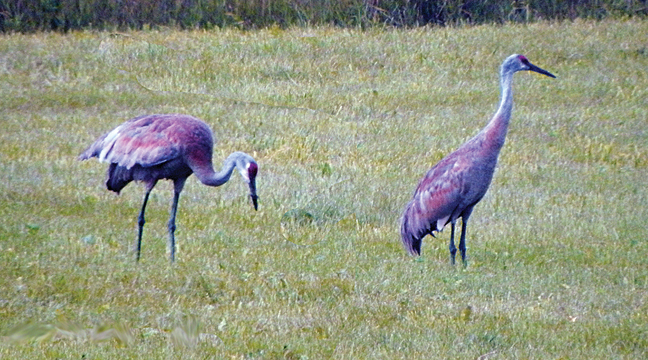
Over the past five years, I’ve spotted a pair of sandhill cranes in the open grass field between our old farm house and the dirt road. But that’s usually been in the fall. It could be that they had already nested for the season, and were trying to load up on food to have enough energy for their southern migration.
They eat seeds, plant tubers, grains, berries, insects, earthworms, mice, snakes and frogs. We have plenty of all of those on the farm and in the woods. Our forest has multiple areas of wetlands and thick brush. And once the farmers in the area harvest their crops, there’s plenty of residual grains and exposed insects for the taking.
I remember the first time I saw them in our field about five years ago. I had never seen any up close, and I was amazed at the size of the birds. To me, they resembled some prehistoric flying animal like the pterodactyl.
Luckily, I was able to quietly creep out our porch door and snap a few photos. They glanced up at me but didn’t fly away. They slowly walked across the field and disappeared into the trees. I really appreciated the fact that they felt our farm was a comfortable and inviting place to stop.
But I’m not the only one who appreciates the beauty of the cranes. Each fall, hundreds of people visit the Sherburne National Wildlife Refuge to get a look at the large flock of cranes during their southern migration.
It’s a stop-over for thousands of cranes that are making their way south from Canada to their wintering ground in the southern U.S. and Mexico.
Last fall on a single day, refuge staff and volunteers counted a record number of cranes in a single day - more than 29,000.
They typically stick around until the weather turns colder and the wetlands freeze over. Then their southern journey begins. They return when the weather is expected to warm up here up north.
I think the extended winter weather here had them a bit confused when they returned this year. Everything was covered with over a foot of snow in our woods. The wetlands were sill frozen. So they had to spend time searching for food and a roosting spot.
But now things have warmed up. There’s exposed grass. Our ponds and wetlands are liquid again. And early Monday morning, as I was walking our dog near the woods, I spotted a pair of sandhill cranes near the tree line at the edge of the field.
They’re back.