


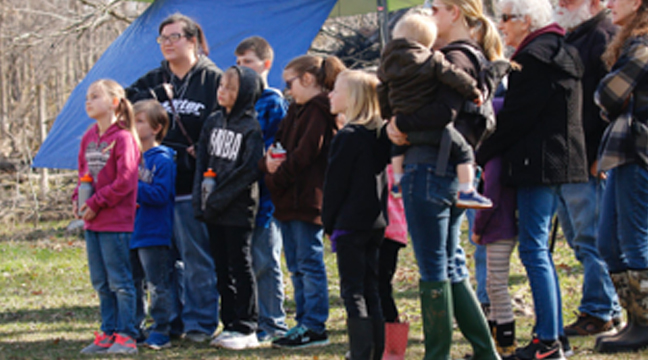

Over 800 people learned about the paleontology of Sherburne County’s Snake River on May 4th, 2022. The educational event was sponsored by the Mammoth Site of Hot Springs South Dakota and hosted by long time residents Tom Barthel and his wife Gail Wilkinson.
Dr. Jim Mead is the Director of Research at the Mammoth Site and has organized and led four “digs” on the Snake River in recent years.
The Snake River and most of Sherburne County is in a geological formation known as the Anoka Sand Plain. The triangular shaped plain extends from St Cloud to St Paul. It includes Sherburne and Anoka Counties and much of Isanti County.
Although sandy, and droughty, the sand plain has many poorly drained areas of peat and muck. Many of those peaty areas entrapped bison at various times over the past 10,000 years.
The Snake River Farm owned by Tom Barthel and Gail Wilkinson has several sites of abundant bison skeletons. The skeletons are well preserved bone, not fossilized.
Two complete bison skeletons have been reconstructed from bones found on the Snake River Farm. One now resides in the National Bison Museum; the other is in the Sherburne County History Center.
The Mammoth Site has built a full reproduction of a dig on the Snake River. That reproduction is on display in the main exhibit room at the Mammoth Site.
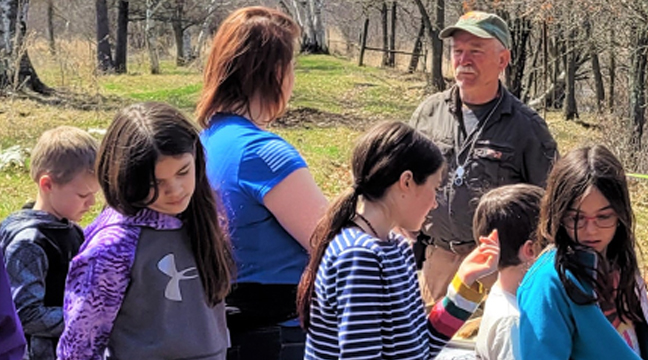
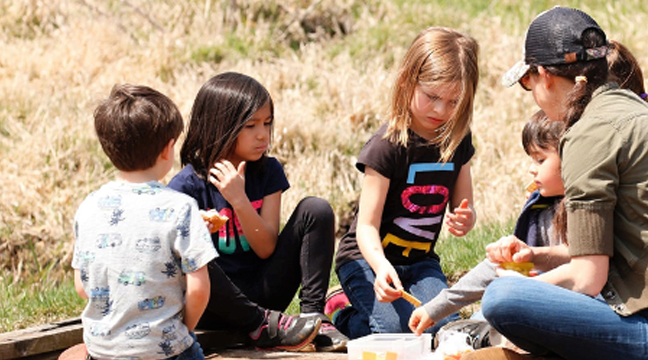
Most of the 800 visitors on Wednesday were home school students and their parents. Dr. Mead and the other scientists dedicated that day to education.
Guests parked at the Snake River Farmstead and were continuously shuttled in four farm wagons to the dig location, about one mile south. The event started at 9 a.m. and ended after 5 p.m.
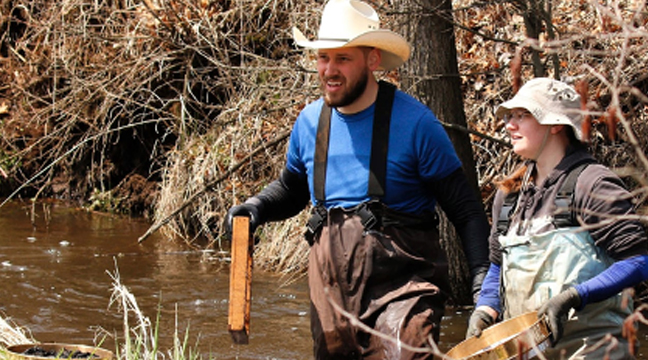
The word “dig” probably gives the wrong impression. The researchers actually work very meticulously, removing earth carefully and slowly and collect and preserve all artifacts of mammals, reptiles, fishes, turtles, birds, plants etc. for later study.
Many items, even tree roots, will be carbon dated. In the first two years the dig held at Snake River Farms was focused on bison and other large animal bones. The focus has now shifted to gaining an understanding of the entire biome of flora and fauna at different locations and different times.
For example, it was initially assumed that the peat was laid down more or less continuously in one long event. By careful boring and sampling, Dr. Mead is identifying areas that were primarily affected by running water, with nearby small fresh ponds that have entrapped muck. Nature is always more complex than we expect.
The balmy weather was a real treat for the event. It was a great day for a wagon ride and a hike in the woods.
When the paleontologists packed up on Friday to head back to South Dakota, after two days on site at Snake River Farms, they were loaded with hundreds of samples for future cataloging and carbon dating and look forward to next year’s dig.
Scientists and helpers from the Mammoth Site, South Dakota State University, the University of Arizona, The Science Museum of Minnesota and the National Bison Museum in Jamestown, ND participated in the week-long dig hosted by Tom Barthel and Gail Wilkinson.
Special thanks to Tom Barthel and Jim Mead of Mammoth Site of Hot Springs, SD for providing information for this article.