
I’ve been leading photo tours to capture stunning images of Common Loons (Gavia immer) for over 10 years now. Each time I take a group of photographers out it’s feels like a new and fun adventure. Each tour I fully expect to see some interesting behaviors of the loons along with many other species of birds and the birds never fail to amaze me in so many ways.
The Common Loon is the main target, but I often take time to capture images of other species of birds such as American White Pelican, Yellow-headed Blackbird, Marsh Wren and everyone’s favorite, Red-necked Grebe.
Each morning starts well before sunrise. The objective is to get on the water in my custom-built pontoon boat and get into position when the sun first peaks over the eastern horizon. I position the boat near a family of loons with the sun directly on the opposite side, then we wait. With the fires in Canada sending smoke in the upper atmosphere, each sunrise has been a fiery red color. This makes for some amazing settings to capture images of loon families in the morning sunrise. But these early mornings mean I am up at four a.m. every morning and we are out late each evening. So, I am averaging four hours of sleep each night. This might explain why this article is a bit rambling in nature.
After 30 minutes of capturing images of the sunrise with the loons, I maneuver the boat around to have the sun at our backs and start to capture images in the traditional way. I slowly move the boat around the lake in search of other birds. Using my binoculars to scan the immediate area and trying to anticipate the birds that might be in the particular habitat. Now and then we get lucky and see a muskrat or otter but mostly we concentrate on capturing images of birds.
At this time of year, most birds are nesting and are busy tending to either building nests, incubating eggs or feeding young. Each species is on its own timeline. Some are just getting ready to start nesting while other birds such as the Common Loon have their chicks already. That is the thing about nature, each species has found its own way to accomplish the same thing, reproduction. While nesting is relatively similar, each species tweaks the process to fit the species particular needs.
Every now and then we are surprised by a new and interesting bird. I often spend extra time in or near cattail marshes. Nearly every time we visit these areas, I can hear a small and secretive bird. It is often buried deep in the cattails with no chance of seeing it. It gives a soft and regular call lasting only one or two seconds. Its call sounds like someone knocking on a wooden door. “knock, knock, knock, knock”. While it is not unusual to hear this bird, seeing them just about never happens. It is the Least Bittern (Lxobrychus exilis).
So recently, after telling everyone a bit about their natural history, and especially noting that we never see them due to their secretive nature, we had two of them jump out of the cattails and started flying around, right out in the open. Several of the participants were able to capture some images of the birds in flight and everyone got a real good look at these uncommon birds.
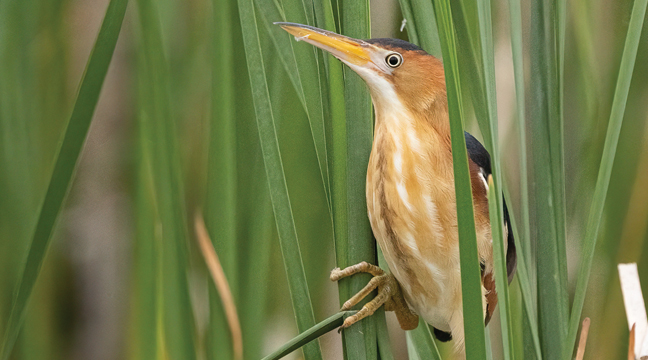
The Least Bittern is the smallest member of the heron family in North America and perhaps the third smallest heron in the world, standing only 11 inches tall. It only weights about 2 to 3.5 ounces, not pounds. This makes them one of the lightest of all the herons.
The Least Bittern spends most of its time walking around in the cattails. The problem is, the cattails are in water, so the bittern uses its long toes to grab the stalks of the cattails, often straddling the stems in the splits position. It does this to move about the cattail marsh, to hunt for food and to find a mate and make a nest.
After seeing the two birds flying around everyone was so happy. We had a brief celebration then started to motor out of the area. While reaching the outer edge of the marsh, I couldn’t believe my eyes. Perched at the base of some cattails, was a Least Bittern right out in the open. We were able to capture some of the best images I have of this bird, thus proving you never know what you will see when you go out into nature. Until next time…
Stan Tekiela is an author / naturalist and wildlife photographer who travels the U.S. to study and capture images of wildlife. He can be followed on www.facebook.com and www.instagram.com. He can be contacted via his web page at www.naturesmart.com.