
A cavity in a tree, excavated by a woodpecker seems normal enough, but when you stop to think about it, this simple cavity in a tree is absolutely remarkable. So, let’s take a closer look at the humble woodpecker cavity.
According to the IOC (International Ornithological Committee) there are 241 species of woodpecker in the world. Here in America, we have 22 species of woodpecker, ranging from the small Downy Woodpecker to the giant Pileated Woodpecker. All these woodpeckers have one thing in common; they all excavate cavities to use for nesting. Because of this, woodpeckers are considered primary cavity nesting birds. In other words, woodpeckers are the primary users of the cavities that they excavate, however there are an estimated 75-80 species of non-woodpeckers that also rely on these cavities to nest. These birds are called secondary cavity nesters, and their very existence depends upon woodpeckers. In a study published in 2017 found that nearly 20% of all birds’ species in the world rely on cavities in trees, for either roosting or nesting.
Most woodpeckers only use the cavities that they excavate for just one brood of young birds. Woodpeckers excavate in dead or dying trees with just a few exceptions. Live trees / wood are too dense and hard for the woodpeckers to excavate. Over the life span of the cavity, it may host dozens of families of baby birds from a wide variety of secondary cavity nesters.
Depending upon the woodpecker species, or how soft the wood, it takes anywhere from four to twenty days for a pair of woodpeckers to excavate a cavity. I say “a pair” because both the male and female do the work. It all depends upon the level of decay in the wood. Obviously the softer the wood the faster it goes. Only a small handful of woodpecker species excavate cavities in live trees. The overwhelming majority are excavated in dead trees or dead limbs of live trees.
In the world of woodpeckers, parenting duties are shared by both adults. Cavities are excavated by both male and female, but the male does slightly more work. When it comes to incubation, the female does most incubating during the day, and the male does the night shift. After they young hatch, both parents bring food to the begging babies.
So many of our most beloved birds such as Eastern Bluebirds, Mountain Bluebirds, and raptors such as American Kestrels and Screech-owls are dependent upon large woodpecker cavities. In one recent study, it showed that of all the cavities found in a forest, only 10 percent of the natural cavities were being used, but 80 percent of the old woodpecker’s cavities were utilized by secondary cavity nesting birds.
I think many people do not realize that many waterfowl species such as Hooded Merganser, Wood ducks and Buffleheads also depend upon cavities in trees to nest. So far, I have been concentrating on nesting and haven’t considered the value of woodpecker cavities for roosting at night. Many species of birds who don’t use cavities for nesting will use a nest cavity for a place to be safe and warm when roosting, especially on long cold winter nights. Many studies show the benefits of roosting inside cavities compared to being out on a tree branch, which leaves them vulnerable to nocturnal predators such as owls.
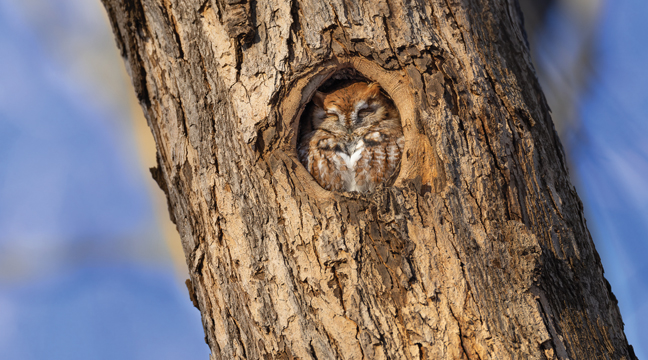
And speaking of owls, all the species of Screech-owls also use woodpecker cavities to nest and also roost, except they roost during the day. All of this was running through my head the other day while I was capturing some images and video of a wonderful Eastern Screech-owl who was enjoying a little sunshine on a cold winter day in the northland.. Until next time…
Stan Tekiela is an author / naturalist and wildlife photographer who travels the U.S. to study and capture images of wildlife. He can be followed on www.facebook.com and www.instagram.com. He can be contacted via his web page at www.naturesmart.com.