
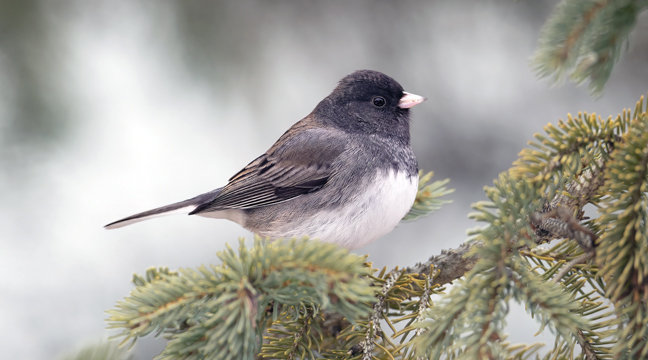
There is a small and common bird that is often described as “bland” that visits your yard each winter and perhaps you don’t even know it. It is charcoal gray in color with a white belly. The males are darker than the females. They have a small pink bill, which is really the only splash of color on this bird. They have a pair of white outer tail feathers that stand out strikingly against the dark tail but are only seen when the bird is in flight.
So, what is this common and unnoticed bird, it is the Dark-eyed Junco (Junco hyemalis). The Dark-eyed Junco is a type of New World sparrow. This means it is not related to the sparrows found in Europe, Asia or Africa. They are unique to the Americas. In summer it is found in the northern reaches of Canada well into the Arctic and in several of the northern tier states where conifer forests can be found.
Its genus name “Junco” is from the Latin word for rush or reed and refers to the grass-like plants. The species name “hyemalis” is also Latin and means winter. So together its scientific name means “a winter bird that lives in reeds”. Well, they got part of it right. They are a winter bird, but it’s not usually seen in reeds or cattails. In summer they live in conifer forests and in winter they are found in open areas.
The Dark-eyed Junco shows up in most backyards in late fall or early winter. They are found in each and every state in the nation during winter and even parts of northern Mexico. To say they are widespread and in everyone’s backyards would be an understatement.
They are highly migratory with the females moving further south than the males. The males tend to stay in the northern states which gives them a head start when returning in the spring to the breeding grounds. Every study shows that the males who return to the breeding grounds first obtain the best territories.
These birds can look highly variable depending upon where you live. There are around 15 subspecies of the Dark-eyed Junco, and this is the very thing that drives a lot of people crazy, me included. So, let’s just say that no matter what your Junco looks like, they are still a Dark-eyed Junco.
For the past 50 or more years, it was believed that small songbirds like the Dark-eyed Junco had no or very limited ability to smell anything. It was thought that the olfactory system in these birds was under-developed to the point of non-functional. However, recent studies done with Dark-eyed Juncos show just the opposite. They do have the ability to smell and even identify individual family members by their unique odor.
Now the most recent studies show that the Dark-eyed Junco have cryptochrome molecules located in the retinas if their eyes. These molecules create light-activated chemical reactions that are sensitive to the Earth’s Magnetic field. In other words, the birds can see the magnetic poles, allowing the birds to determine which way is north or south.
To add to this amazing superpower, the Juncos have a strong sense of smell that help the birds use the odor of the land to help them determine their exact location. It is thought the birds can smell the landscape as they move about during migration. Experiments are showing the birds can smell the chemicals in the soil, lakes, streams and other habitats. These two amazing senses help the birds to navigate across unfamiliar territory when migrating.
Combining these senses help determine how far they need to fly during migration and when and if they have reached their final destination. As you can see, we are just starting to understand the superpowers that many birds possess. The next time you look out your window and see one of these Juncos, think about how these birds eyed and smelled their way to visit your backyard. Until next time…
Stan Tekiela is an author / naturalist and wildlife photographer who travels the world to capture images of wildlife. He can be followed at www.Instagram.com and www.Facebook.com. He can be contacted via his website at www.NatureSmart.com.